Rockchip Developer Guide Linux IOMMU
ID: RK-KF-YF-110
Release Version: V1.0.0
Release Date: 2019-12-23
Security Level: □Top-Secret □Secret □Internal ■Public
DISCLAIMER
THIS DOCUMENT IS PROVIDED “AS IS”. FUZHOU ROCKCHIP ELECTRONICS CO., LTD.(“ROCKCHIP”)DOES NOT PROVIDE ANY WARRANTY OF ANY KIND, EXPRESSED, IMPLIED OR OTHERWISE, WITH RESPECT TO THE ACCURACY, RELIABILITY, COMPLETENESS,MERCHANTABILITY, FITNESS FOR ANY PARTICULAR PURPOSE OR NON-INFRINGEMENT OF ANY REPRESENTATION, INFORMATION AND CONTENT IN THIS DOCUMENT. THIS DOCUMENT IS FOR REFERENCE ONLY. THIS DOCUMENT MAY BE UPDATED OR CHANGED WITHOUT ANY NOTICE AT ANY TIME DUE TO THE UPGRADES OF THE PRODUCT OR ANY OTHER REASONS.
Trademark Statement
"Rockchip", "瑞芯微", "瑞芯" shall be Rockchip’s registered trademarks and owned by Rockchip. All the other trademarks or registered trademarks mentioned in this document shall be owned by their respective owners.
All rights reserved. ©2019. Fuzhou Rockchip Electronics Co., Ltd.
Beyond the scope of fair use, neither any entity nor individual shall extract, copy, or distribute this document in any form in whole or in part without the written approval of Rockchip.
Fuzhou Rockchip Electronics Co., Ltd.
No.18 Building, A District, No.89, software Boulevard Fuzhou, Fujian,PRC
Website: www.rock-chips.com
Customer service Tel: +86-4007-700-590
Customer service Fax: +86-591-83951833
Customer service e-Mail: fae@rock-chips.com
Preface
Overview
IOMMU is used for the conversion of 32-bit virtual addresses and physical addresses. It has read-write control bits and can generate page fault exceptions and bus exception interrupts.
Product Version
| Chipset | Kernel Version |
|---|---|
| All chipset | 4.4 & 4.19 |
Intended Audience
This document (this guide) is mainly intended for:
Technical support engineers Software development engineers
Revision History
| Version | Author | Date | Change Description |
|---|---|---|---|
| V1.0.0 | Simon.Xue | 2019-12-23 | Initial version |
[TOC]
IOMMU Structure
It is using 2 level table structure, which as follow:
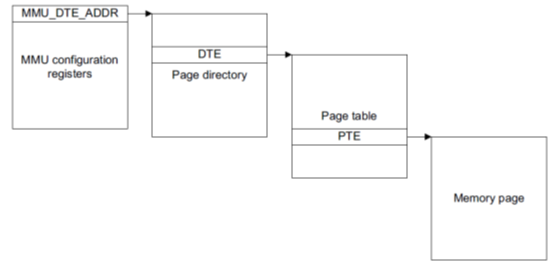

32bit address structure, the first 10 bits of the first-level page table offset, the middle 10 bits of the second-level page table offset, and the last 12 bits within the page offset.
DTE structure:

bit0:indicates whether the next page table present
PTE structure:
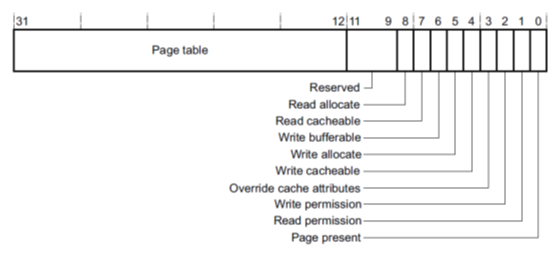
bit0:indicates whether the actual physical page present
bit1:Read permission
bit2:write permission
IOMMU Driver
Driver File
The driver file is in:
drivers/iommu/rockchip-iommu.c
DTS Configuration
The reference DTS configuration is Documentation/devicetree/bindings/iommu/rockchip,iommu.txt here introduce the follow parameter mainly:
compatible = "rockchip,iommu";
For all the iommu of the device, the compatible field value is the same
interrupts = <GIC_SPI 119 IRQ_TYPE_LEVEL_HIGH 0>;
It used for exceptional interrupt, such as page fault interrupts.
-
clocks = <&cru ACLK_VOP1>, <&cru HCLK_VOP1>; -
clock-names = "aclk", "hclk";
IOMMU and master share clock, here IOMMU driver controls clock separately
power-domains = <&power RK3399_PD_VOPL>;
IOMMU driver manipulates PD.
-
iommu-cells = <0>;Here value must be 0, the reason refer to iommu.txt
IOMMU Usage
The ROCKCHIP IOMMU driver depends on the IOMMU framework (drivers/iommu/iommu.c), which mainly implements the callback function in struct iommu_ops rk_iommu_ops, and then the master calls the API provided by the iommu framework to operate on iommu, as follows:
-
iommu attach
iommu_attach_device -> rk_iommu_attach_device/* enable iommu */ -
iommu detach
iommu_detach_device -> rk_iommu_detach_device/* disable iommu */ -
iommu map
iommu_map -> rk_iommu_mapCreate a page table and establish the mapping relationship between the virtual address and the physical address. When debugging, open the dbg in iommu_map and observe the mapping
-
iommu unmap
iommu_unmap -> rk_iommu_unmapRemove the mapping relationship between the virtual address and the physical address, and release the virtual address space. When debugging, open the dbg in iommu_unmap and observe unmapping
-
domain alloc
iommu_domain_alloc -> rk_iommu_domain_allocApply page table base address for attach / detach operation
-
domain free
iommu_domain_free -> rk_iommu_domain_freeFree page space
-
dump iommu
Take RK3399
vopl_iommuas example, assume the current virtual address is 0x00001000, dump page table as follow order-
obtain the level 1 page table base address: DT
io -4 0xff8f3f00
-
calculate page level 1 page table offset
index1 = VA >> 22
-
calculate page level 1 page table physical address: DTE
DTE = index1 * 4 + DT
-
obtain the level 2 page table base address: PT
PT = io -4 DTE
-
calculate page level 2 page table offset
index2 = VA && 0x3ff000
-
calculate page level 1 page table physical address: PTE
PTE = index2 * 4 + PT
-
obtain PAGE physical address: page
page = io -4 PTE
-
Calculate in-page offset
offset = page + (VA && 0xfff)
offset is the physical address corresponding to the virtual address 0x00001000, which the master can use to analyze whether the data is correct
-
-
dma-mapping
-
if dev is not iommu device
ARM32:
dev->dma_ops = arm_dma_ops;ARM64:
dev->dma_ops = arm64_swiotlb_dma_ops; -
if dev is iommu device
ARM32:
dev->dma_ops = iommu_ops;ARM64:
dev->dma_ops = iommu_dma_ops;
take
dma_alloc_attrsas example:-
For non-iommu dev, call alloc callback from a's dma_ops to alloc continuous physical memory and kernel mode virtual address
-
For iommu dev, call the alloc callback from b's dma_ops to alloc physical memory, and call it through the iommu framework
iommu_mapto create the IOMMU page table, establish the mapping between the virtual address and the physical address, and return the first IOMMU virtual address and kernel mode virtual address
-
One of the easiest steps to use IOMMU
1. domain = iommu_domain_alloc(&platform_bus_type);
2. iommu_map(domain, iova, paddr, size, prot);
3. iommu_attach_device(domain, dev);
4. master access memory via iommu
IOMMU is a basic component that can be embedded in various memory allocation frameworks, such as ION / DRM. Taking DRM under the ARM64 environment as an example, a complete IOMMU buffer allocation and mapping process is as follows
rockchip_gem_alloc_buf ->
rockchip_gem_get_pages ->
rockchip_gem_iommu_map ->
iommu_map_sg ->
iommu_map
The IOMMU mapping process by passing FD is as follows:
struct dma_buf *dmabuf = dma_buf_get(fd) ->
dma_buf_attach -> dma_buf_map_attachment ->
map_dma_buf -> drm_gem_map_dma_buf ->
dma_map_sg_attrs -> map_sg ->
__iommu_map_sg_attrs ->
iommu_dma_map_sg ->
iommu_map_sg ->
iommu_map
Kernel configuration
Symbol: ROCKCHIP_IOMMU [=y]
Type  : boolean
Prompt: Rockchip IOMMU Support
	Location:
		-> Device Drivers
			-> IOMMU Hardware Support (IOMMU_SUPPORT [=y])
	Defined at drivers/iommu/Kconfig:211
    Depends on: IOMMU_SUPPORT [=y] && (ARM || ARM64 [=y]) && (ARCH_ROCKCHIP [=y] ||
                COMPILE_TEST [=n])
    Selects: IOMMU_API [=y] && ARM_DMA_USE_IOMMU
IOMMU FAQ
-
Pagefault interrupt
A pagefault interrupt occurs, indicating that the current IOMMU has a page fault exception, that is, the virtual address currently being accessed does not create a matched map. There are caused by three possibilities, the first one is to access the address not mapped, the other is access beyond the mapping area, and the third is to start accessing without mapping. In history, three situations above all have appeared in master.
-
Error IOMMU enable stall
This is likely to be that a pagefault exception has occurred in IOMMU, the master does not handle the exception but continue to visit, which can be find from the log.
-
Error access IOMMU registers
It is likely caused by the master's processing of PD, that is, the use of
pm_runtime_get_sync / pm_runtime_put_syncis unreasonable, which also means accessing to the IOMMU register without opening the IOMMU power domain. -
Continue to trigger IOMMU interrupt
The IOMMU interrupt number is incorrect in DTS file.
-
Splash screen
During vop display, enable IOMMU may leads to vop access memory error. In the chip without frame effect function, should not enable IOMMU until vop is in idle status.
-
Error IOMMU register
It is very likely caused by the master accesses the IOMMU register out of IOMMU register range or the master resets the entire IP.
-
Device Link
IOMMU integrates device link operation and hands over the PD operation authority to the master. The master needs to pay attention to the use of
pm_runtime_get / pm_runtime_put. -
Shared IOMMU
In the ARM32 environment, the master of the shared IOMMU needs to maintain independent page tables, such as VEPU and VDPU. Before each accessing, the matched page table needs to be attached. ARM64 is a shared page table, and does not need to be attached every time.