Rockchip FreeRTOS SPIFLASH
ID: RK-KF-YF-052
Release Version: V1.0.2
Date: 2020-02-21
Security Level: □Top-Secret □Secret □Internal ■Public
DISCLAIMER
This document is provided "as is". Fuzhou Rockchip Electronics Co., Ltd. ("the Company") makes no express or implied representations or warranties regarding the accuracy, reliability, completeness, merchantability, fitness for a particular purpose, or non-infringement of any statements, information, or content in this document. This document is for reference as a usage guide only.
Due to product version upgrades or other reasons, this document may be updated or modified from time to time without any notice.
Trademark Statement
"Rockchip", "Rockchip", and "Rockchip" are registered trademarks of the Company and belong to the Company.
All other registered trademarks or trademarks mentioned in this document are owned by their respective owners.
Copyright © 2019 Fuzhou Rockchip Electronics Co., Ltd.
Without the Company's written permission, no individual or entity may extract or copy part or all of the content of this document, or distribute it in any form, beyond the scope of fair use.
Fuzhou Rockchip Electronics Co., Ltd.
Address: No. 18, Area A, Software Park, Tongpan Road, Fuzhou, Fujian Province
Website: www.rock-chips.com
Customer Service Phone: +86-4007-700-590
Customer Service Fax: +86-591-83951833
Customer Service Email: fae@rock-chips.com
Preface
Overview
This document mainly describes the principles and usage of ROCKCHIP FreeRTOS SPI Flash.
Product Versions
| Chip Name | Kernel Version |
|---|---|
| RK2206 | FreeRTOS V10.0.1 |
Intended Audience
This document (guide) is mainly applicable to the following engineers:
Technical Support Engineers Software Development Engineers
Revision History
| Version | Author | Modification Date | Revision Description |
|---|---|---|---|
| V1.0.0 | Lin Dingqiang | 2019-12-03 | Initial version |
| V1.0.1 | Lin Dingqiang | 2019-12-12 | Added SPI Flash framework chapter |
| V1.0.2 | Lin Dingqiang | 2020-02-21 | Adjusted heading hierarchy |
Table of Contents
[TOC]
Introduction
Supported Devices
RK MCU products use only SPI Nor flash; SPI Nand is not supported.
SPI Nor has advantages such as small package, faster read speed compared to other small-capacity non-volatile storage, fewer pins, and simpler protocol. Common SPI Nor on the market supports 1-wire, 2-wire, and 4-wire transmission. SPI Nor also features bit-flip resistance, byte addressing, and no wait delay for read operations (data is transferred in the next beat after sending cmd and address), thus supporting XIP technology (eXecute In Place).
The RK RTOS SPI flash framework provides a universal SPI Nor interface and an automated XIP solution.
Controller
RK platform SPI Flash controllers include FSPI and SPI solutions.
FSPI (Flexible Serial Peripheral Interface) is a flexible serial transmission controller with the following main features:
- Supports SPI Nor, SPI Nand, SPI protocol Psram and SRAM
- Supports SPI Nor 1-wire, 2-wire, and 4-wire transmission
- XIP technology
- DMA transfer
SPI (Serial Peripheral Interface) is a general-purpose serial transmission controller that supports external SPI Nor and SPI Nand. The RK RTOS platform currently only supports SPI Nor implementation.
XIP Technology
XIP (eXecute In Place) means that the CPU directly fetches instructions from the memory space through the mapped address, i.e., the application can run directly in the flash memory without having to read the code into system RAM first. Therefore, the run address of in-place execution code is the corresponding mapped address. Since SPI Nor XIP only supports read, only code segments and read-only information can be placed in SPI Nor.
In addition to CPU XIP access to SPI flash, FSPI also supports other modules such as DSP to obtain flash data in a similar way, like accessing a "read-only sram" space. For detailed FSPI information, refer to the FSPI chapter in the TRM.
Driver Framework
To support both FSPI and SPI controllers, a controller layer is abstracted, dividing the entire driver framework into three layers:
- RTOS Driver layer, completing the following logic:
- RTOS device framework registration
- Register controller and operation interfaces to the HAL_SNOR protocol layer
- Encapsulate read/write/erase interfaces for users
- HAL_SNOR protocol layer based on SPI Nor transfer protocol
- Controller layer
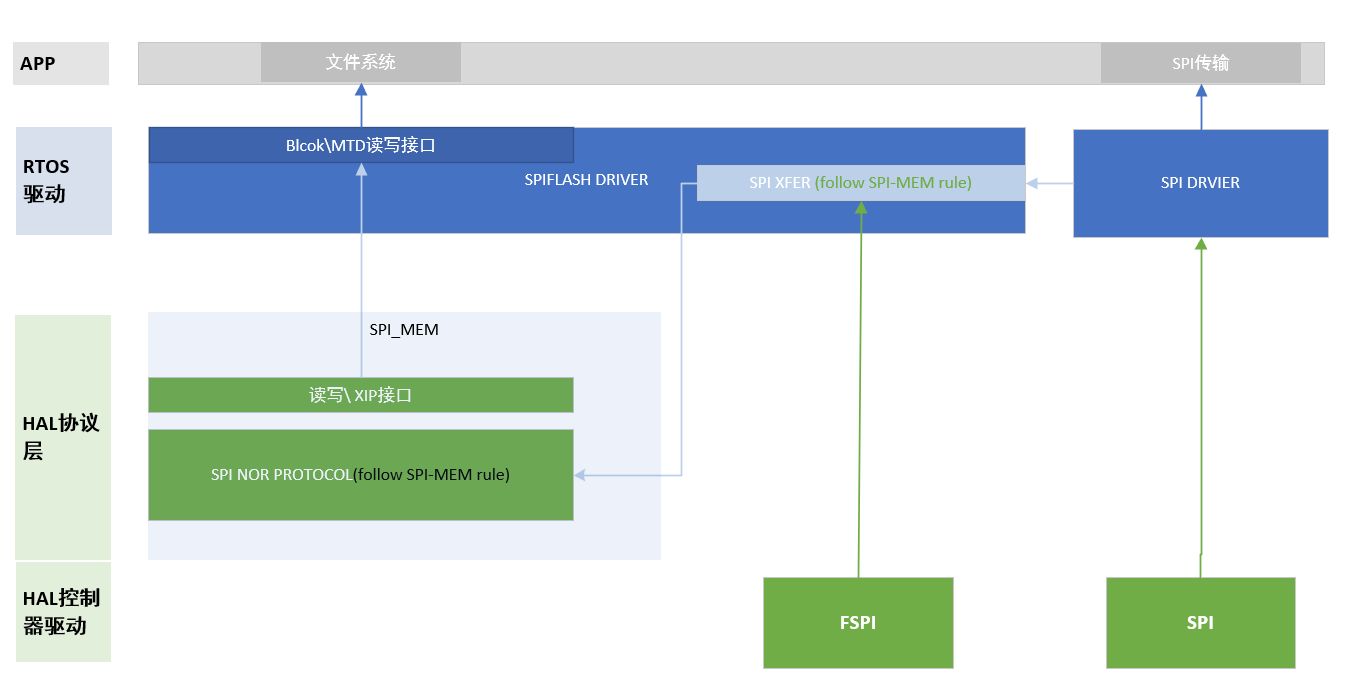
FreeRTOS implementation based on FSPI controller:
- OS driver layer: SpiFlashDev.c implements:
- Encapsulate SPI_Xfer based on FSPI HAL layer read/write interfaces, register FSPI host and SPI_Xfer to the HAL_SNOR protocol layer
- Encapsulate read/write/erase interfaces provided by the HAL_SNOR protocol layer
- Register OS device driver
- Protocol layer: hal_snor.c in the HAL package implements the SPI Nor flash protocol layer
- Controller layer: hal_fspi.c in the HAL package implements the FSPI controller driver code
FreeRTOS implementation based on SPI controller:
- OS driver layer: SpiFlashDev.c implements:
- Encapsulate SPI_Xfer based on SPI OS driver read/write interfaces, register SPI host and SPI_Xfer to the HAL_SNOR protocol layer
- Encapsulate read/write/erase interfaces provided by the HAL_SNOR protocol layer
- Register OS device driver
- Protocol layer: hal_snor.c in the HAL package implements the SPI Nor flash protocol layer
- Controller layer: hal_spi.c in the HAL package implements the SPI controller low-layer driver code; SpiDevice.c implements RTOS SPI DRIVER device registration and interface encapsulation
Notes:
- The above implementations correspond to the accompanying diagram; refer to it together.
- Since RK SPI DMA transfer related code is in the OS Driver layer, and the SPI controller is also used for many other devices besides SPI Nor, there is hardware resource boundary protection. Therefore, the SPI controller in the SPI Flash framework should not directly use the HAL layer hal_spi.c driver but should use the SPI interface from the OS Driver.
Configuration
All SPI Flash driver framework configurations can be flexibly adjusted through Kconfig. As described in section 1.4, the complete SPI flash driver framework consists of three abstract layers, and the corresponding configuration is also divided into three levels:
RTOS Driver Layer Configuration:
    BSP Driver  --->
        [*] Enable SPIFASLH  --->
        (80000000) Reset the speed of SPI Nor flash in H
HAL_SNOR Protocol Layer Controller Socketing Configuration:
FSPI controller solution:
	HAL Options	--->
        -*- Use HAL SNOR Module
        	Choose SPI Nor Flash Adapter (Attach FSPI controller to SNOR)  --->
        		(X) Attach FSPI controller to SNOR
        		( ) Attach FSPI controller to SNOR
SPI controller solution:
	HAL Options	--->
        -*- Use HAL SNOR Module
        	Choose SPI Nor Flash Adapter (Attach SPI controller to SNOR)  --->
        		( ) Attach FSPI controller to SNOR
        		(X) Attach SPI controller to SNOR
        		(0)     the id of the SPI device which is used as SPIFLASH adapter (NEW)
Controller Driver Configuration
FSPI controller configuration:
[*] Use HAL FSPI Module
	[*]     Enable FSPI XIP
SPI controller configuration:
Please refer to the "Rockchip_Developer_Guide_Linux_SPI_CN.md" document.
Code and Interface
Code
"src/driver/spiflash/SpiFlashDev.c" "include/driver/SpiFlashDev.h"
Function Interfaces
Device Creation Interface
HDC SpiFlashDev_Create(uint8 DevID, void *arg);
rk_err_t SpiFlashDev_Delete(uint8 DevID, void *arg);
The arg parameter currently has no practical meaning and is only reserved as an interface placeholder; it can be omitted.
Get SPI Flash Device Information
Since some file systems need to obtain SPI Nor information, the SPI Flash driver refers to the MTD framework approach, setting the SPI Flash handle as a global variable. It can be cast to struct _SPIFLASH_DEVICE_CLASS to obtain the minimum erase block size and capacity information.
typedef  struct _SPIFLASH_DEVICE_CLASS
{
    DEVICE_CLASS stSpiFlashDevice;
    pSemaphore osSpiFlashOperSem;
    uint32 blockSize;	// SPI Nor flash minimum erase size, in bytes
    uint32 blockStart;	// Default is address 0;
    uint32 blockEnd;	// SPI Nor size, in bytes;
} SPIFLASH_DEVICE_CLASS;
In addition to the global handle, a general interface for obtaining SPI Nor flash capacity information is provided, in bytes:
rk_err_t SpiFlashDev_GetSize(HDC dev, uint32_t *Size);
Data Transfer Interfaces
Common file systems for SPI Nor require two types of data read/write interfaces.
- Block size aligned read/write interface, e.g., FAT fs;
- Byte-level read/write interface and block size erase interface, e.g., spifs, littlefs.
Since SPI Nor flash capacity is small, 128KB block erase is inefficient. Therefore, the block size is set to the minimum erase unit - sector (4KB).
Block interface:
For file systems like FAT, block write is essentially an overwrite implementation. Therefore, the RK SPI Flash block write interface implements the combined operation of block write (actually sector in SPI Nor) and block write.
/* For block write/read, maybe good for FAT fs */
rk_size_t SpiFlashDev_WriteBlk(HDC dev, rk_size_t sec, const uint8_t *data, rk_size_t nSec);
rk_size_t SpiFlashDev_ReadBlk(HDC dev, rk_size_t sec, uint8_t *data, rk_size_t nSec);
Byte interface:
/* For byte write/read/erase, maybe good for small fs */
rk_size_t SpiFlashDev_Write(HDC dev, rk_size_t off, const uint8_t *data, rk_size_t len);
rk_size_t SpiFlashDev_Read(HDC dev, rk_size_t off, uint8_t *data, rk_size_t len);
rk_err_t SpiFlashDev_Erase(HDC dev, rk_size_t off, rk_size_t len);
XIP Implementation Notes
As introduced earlier, SPI Nor supports XIP functionality. If the FSPI controller-based SPI Nor solution is selected, XIP functionality is automatically enabled. The following introduces some notes regarding XIP in product applications.
Adding XIP Support
When using the FSPI-based SPI Flash solution and configuring according to section 1.2 regarding FSPI configuration, SPI Flash will default to using XIP functionality. To disable this feature, turn off the "Enable FSPI XIP" configuration.
XIP Enable/Disable During Usage
The RK SPI Flash framework automatically enables/disables XIP functionality as needed; the customer does not need to call the enable/disable interfaces. Details are as follows:
XIP On
Due to the long erase/write time characteristics of SPI Nor, SPI Nor does not support erase/write under XIP. Therefore, when SPI Nor flash has erase or write requests (e.g., file system write requests), the software calls the XIP suspend interface to switch the SPI Nor controller FSPI to normal mode. During this period, XIP functionality is unavailable. The complete suspend XIP switch flow is as follows:
- Notify all master modules affected by XIP disable to suspend XIP operations
- Disable global interrupts to avoid interrupts causing CPU to execute XIP code placed in SPI Nor
- Disable XIP
XIP Off
When SPI Nor flash erase/write is complete and FSPI is idle, the SPI Flash driver will restore XIP functionality. That is, when there are no erase/write operations, FSPI always enables XIP functionality. The complete XIP resume flow is as follows:
- Enable XIP
- Enable global interrupts
- Notify all XIP suspended devices to resume XIP usage
The above operation entry points are as follows:
static void SpiFlashDev_xipSuspend(void)
static void SpiFlashDev_xipResume(void)
Summary
- If the SPI Nor component is driven by the FSPI controller, XIP functionality is enabled by default
- The SPI Nor controller FSPI enables XIP functionality by default in idle state. At this time, devices supporting the XIP path can access the XIP memory mapped address to obtain data on SPI Nor
- The SPI Nor controller FSPI disables XIP functionality during erase and write operations
- During the SPI Nor controller FSPI XIP enable/disable process, corresponding devices must be notified to stop/resume XIP access. Follow the operations described in "XIP Off" above
- When XIP is disabled, global interrupts are also disabled
Function Interface Call Example
Refer to shell_spiflash.c.
Shell Usage Example
Create Device
spiflash.create <spi devid> /* e.g., spi.create 0 */
Data Transfer
The data transfer interfaces correspond to the read/write interfaces described in section 1.2.
    "readblk",   SpiFlashDevShellReadBlk,  "block read data from spiflash device", "spiflash.read <devID> <from> <size>",
    "writeblk",  SpiFlashDevShellWriteBlk, "block over write data to spiflash device", "spiflash.write <devID> <from> <size> <value>",
    "read",      SpiFlashDevShellRead,     "read data from spiflash device", "spiflash.read <devID> <from> <size>",
    "write",     SpiFlashDevShellWrite,    "write data to spiflash device", "spiflash.write <devID> <from> <size> <value>",
    "erase",     SpiFlashDevShellErase,    "erase spiflash device by sector size", "spiflash.erase <devID> <from> <size>",
Frequently Asked Questions
-
How to determine if SPI flash has been successfully mounted?
Check whether there is a spiflash device node in the shell window.
-
What does "Init adapte error ret= -19" mean?
"Init adapte error ret= -19" is the return result print of the storage driver's initialization function snor_adapt. The corresponding error codes are as follows:
a. -1: SPI Nor ID is 0xff, possibly due to poor SPI Nor soldering. Check the circuit and signals.
b. -19: The component is not in the supported list. Contact RK engineers to add support for the corresponding component.
c. -22: SPI controller not found.
-
Does always-on XIP consume extra power?
FSPI has a timeout mechanism. After the controller is idle for a certain period, it automatically releases CS, and SPI Nor enters an idle low-power state. Therefore, there is no significant power consumption difference.
-
If multiple masters access SPI Nor through XIP simultaneously, will there be conflicts?
When multiple masters access XIP simultaneously, the bus arbitrates and completes transfers serially. Requests will be queued on the bus.
-
Should XIP be used for products with frequent file system read/write operations?
For products with frequent file system writes, it is recommended to place the code segment in sram or psram and disable the FSPI XIP function. Otherwise, RTOS real-time performance will be affected. Similarly, when using XIP to run code segments, SPI Nor erase and write operations should be minimized.
-
After enabling XIP, does the file system read disable XIP?
After enabling XIP, the file system read is implemented by the driver directly through XIP access, so XIP is not disabled.
-
If there is no partition table on SPI Nor, can partitions still be mounted?
The flash partition must be burned to the flash frontend. RK's current SPI Nor flash storage driver only supports parsing and mounting partitions burned in the flash.